Uzbekistan, in brief.
Most travellers know little about Uzbekistan before they land. Here is the short version: what makes it unusual, what happened here, and what to sort out before you fly.
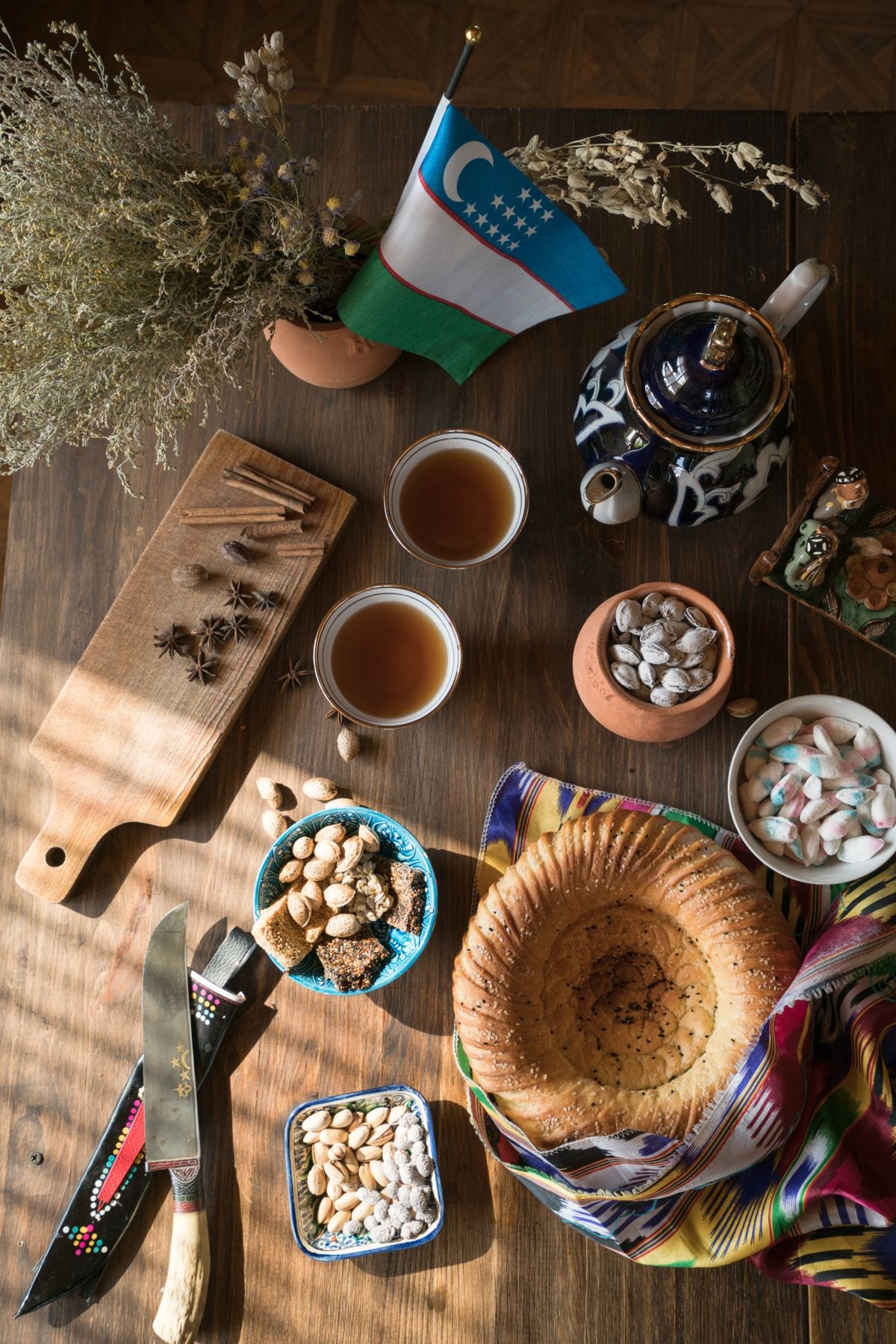
Things most people don’t know.
Uzbekistan lies in the heart of Central Asia, home to more than 37 million people and to cities far older than its borders.
- 2
The world has only two doubly landlocked countries: Uzbekistan and Liechtenstein. Reaching the sea means crossing at least two borders.
- 1977
Tashkent opened the first metro in Central Asia. Its stations are decorated with marble, chandeliers and ceramic panels.
- 2016
UNESCO recognised the culture of plov, the rice dish cooked for weddings and festivals, as intangible cultural heritage.
- Algorithm
The word comes from al-Khwarizmi, a 9th-century mathematician from Khorezm, the region around Khiva. Algebra comes from the title of his book.
- 980
Ibn Sina, known in Europe as Avicenna, was born near Bukhara. His Canon of Medicine was taught in European universities for centuries.
- Choy
Choy means tea. Green tea is poured for guests before anything else, and a half-filled cup is a courtesy: your host wants to keep refilling it.
A short history.
For more than two thousand years, the oasis cities of this land have stood on the routes between China, Persia, India and the Mediterranean.
- Antiquity
Oasis cities
Samarkand, Bukhara and Khiva grew up around rivers and oases. Alexander the Great took Samarkand, then called Maracanda, in 329 BC.
- 8th century
The Silk Road
Caravans carried silk, spices, glass and ideas through these cities. Samarkand became the first city in the Islamic world to make paper.
- 9th to 11th centuries
A golden age of learning
Scholars such as al-Khwarizmi, al-Biruni and Ibn Sina came from this region, and Bukhara was one of the great centres of learning in the Islamic world.
- 1220
The Mongols
Genghis Khan’s armies sacked Bukhara and Samarkand. Legend says the Kalyan Minaret in Bukhara was one of the few buildings spared.
- 14th and 15th centuries
Amir Timur and his heirs
Timur made Samarkand his capital and brought in craftsmen from across his empire. His grandson Ulugh Beg built an observatory whose star catalogue was among the most accurate of its time.
- 16th to 19th centuries
Khanates and empires
The region divided into rival states centred on Bukhara, Khiva and Kokand. Babur, born in Andijan, went south and founded the Mughal Empire in India. In the 1860s and 1870s the Russian Empire took control.
- 1924
The Soviet era
Uzbekistan became a Soviet republic. Over the following decades cotton fields spread, the Aral Sea began to shrink, and Tashkent was rebuilt after the 1966 earthquake.
- 1991
Independence
Uzbekistan declared independence on 31 August 1991 and celebrates it every 1 September. In recent years it has opened its doors to visitors, with visa-free entry for dozens of countries.
Visas and arrival.
For many travellers, getting in is now simple. Rules do change, so check the official sources below before you book.
Visa-free for about 90 countries
Citizens of the UK, the European Union, Canada, Australia, Japan, South Korea and many other countries can stay up to 30 days without a visa. United States citizens joined the list on 1 January 2026.
E-visa for other passports
If your country is not on the visa-free list, you can usually apply online through the official e-visa portal. Leave plenty of time before you fly.
Passport validity
Your passport should be valid for at least three months after the day you arrive.
Registration within three days
Every visitor must be registered at their address within three days of arrival. Hotels and guesthouses do this for you; if you stay with friends, they can register you online.
Customs declaration
Declare cash over US$10,000 and any prescription medicines when you arrive, and keep your copy of the declaration until you leave.
Is Uzbekistan safe?
Most visitors are surprised by how relaxed it feels, and most trips are trouble-free. A few local rules matter more than crime.
A low risk rating
In 2026 the US State Department placed Uzbekistan at its lowest advisory level: exercise normal precautions.
Tourist police
Dedicated tourist police work in the main historic cities, including Tashkent, Samarkand, Bukhara and Khiva. In an emergency, call 102 for police and 103 for an ambulance.
Check your medicines
Some common medicines, including those containing codeine, are restricted. Carry your prescriptions, declare prescription medicines on arrival and check the official lists before you pack.
Leave the drone at home
Bringing in or flying a drone needs permits arranged in advance. Without them, you risk fines and confiscation.
Everyday care
Watch your bag in busy bazaars and on public transport, and agree a taxi fare first or book through a ride-hailing app.
Dress and summer heat
Uzbekistan is a secular country with a Muslim majority; cover shoulders and knees at mosques and shrines. In July and August temperatures can pass 40°C, so sightsee early and late.
Still have questions?
Our local team is happy to help with visas, routes and the small details before you book.